AI• May 19, 2026
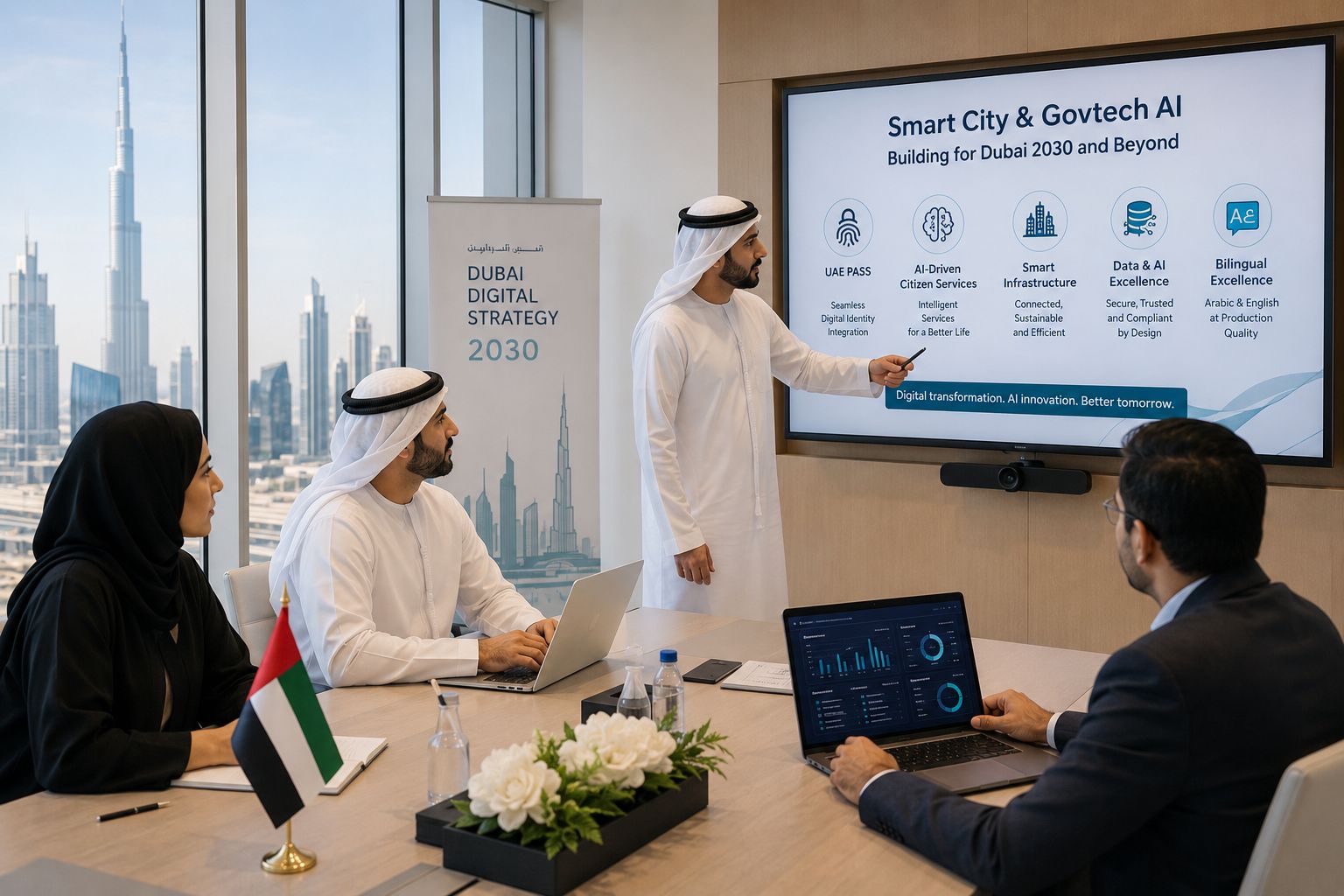
Smart City and Govtech AI: Building for Dubai 2030 and Beyond
UAE government AI is a once-in-a-generation contract opportunity. Here is what smart city AI actually requires — UAE PASS, PDPL, Arabic-first UX, ICV procurement.
The UAE is in the middle of a once-in-a-generation government digital transformation cycle. Dubai's Digital Strategy, Abu Dhabi's AI strategy, the UAE National AI Strategy 2031, and the country's leadership ambitions in artificial intelligence have created a procurement environment with very few global equivalents. Government and semi-government entities, RTA, DEWA, ADNOC Digital, Emirates Group, Dubai Health, ADWEA, Department of Government Enablement, Smart Dubai, TAMM, are all actively investing in AI-anchored citizen services, smart-city infrastructure, and government workflow automation. The contracts being awarded in 2026-2028 will be enormous.
But the procurement is not open to everyone. The UAE government and the major semi-government entities have specific expectations of partners, onshore presence in Dubai or Abu Dhabi, Arabic-language delivery capability at production quality, PDPL compliance, ICV (In-Country Value) contribution, integration capability with UAE PASS and the broader UAE digital government stack, and demonstrated experience with the cadence and quality bar of GCC enterprise delivery.
This pillar is a practical guide to what smart city and govtech AI delivery actually requires in the UAE, not a strategy slide deck, not a vendor pitch. What Dubai 2030 and the UAE National AI Strategy 2031 mean operationally. What integration with UAE PASS and the Smart Dubai stack involves. How PDPL applies to government and citizen data. Why bilingual Arabic-English delivery is not optional. How ICV procurement criteria work. And what a credible delivery posture looks like for partners aspiring to compete in this market.
What Dubai 2030 and the UAE National AI Strategy 2031 actually mean operationally
The headline strategies are well-publicized. The operational implications for technology partners are less well understood.
Dubai's Digital Strategy commits the emirate to becoming one of the most digitally enabled cities in the world, paperless government, AI-anchored citizen services, smart-city infrastructure, and an integrated data backbone connecting Dubai government entities. The UAE National AI Strategy 2031 aims to position the UAE as a global leader in artificial intelligence across sectors. Abu Dhabi's AI strategy, anchored by entities like G42 and the Advanced Technology Research Council, focuses on sovereign AI infrastructure, healthcare AI, and large-scale public sector AI deployment.
What this means for technology partners is that government procurement is no longer about isolated digital projects. It is about contributing to an integrated, government-wide digital fabric. Solutions are evaluated not just on their standalone merit but on their fit with the broader stack. Integration with UAE PASS, Smart Dubai infrastructure, and emirate-level data platforms is increasingly a requirement, not a nice-to-have.
Three implications follow.
Integration capability is a precondition, not a feature
Partners that cannot demonstrate prior integration with UAE PASS, Smart Dubai government services, or comparable infrastructure will struggle to make the shortlist for material government work. Capability needs to be demonstrated through reference deployments, not claimed through capability statements.
Data sovereignty and PDPL are non-negotiable
Citizen data and government workloads are subject to PDPL and to sector-specific data sovereignty expectations. Onshore hosting, UAE-resident data, and PDPL-aligned data handling are baseline requirements for government work, not advanced compliance considerations.
Bilingual delivery is a production-quality requirement
Government citizen services in the UAE must work at production quality in Arabic and English. Bolted-on translation does not pass quality review. Right-to-left UX, dialect handling, gender agreement, and cultural context all need to be designed in. This is examined in detail below.
UAE PASS integration: the citizen identity layer
UAE PASS is the unified national digital identity for UAE citizens, residents, and visitors. It is the gateway to government and increasingly private-sector digital services. For AI-anchored citizen services, UAE PASS integration is the table-stakes capability.
Functionally, UAE PASS provides three things for AI citizen services. Identity verification, confirming that the user is who they claim to be, at the assurance level appropriate to the service. Single sign-on across government services, eliminating the friction of separate logins. Digital signature capability, letting citizens authorize consequential actions cryptographically.
From an integration perspective, UAE PASS exposes OIDC-compatible authentication, digital signature APIs, and document attestation services. The integration patterns are well-documented and the operating standards are clear. The complexity is rarely in the protocol level. It is in the user experience design, the consent capture, the assurance level mapping to use cases, and the fallback handling for users without UAE PASS.
Common implementation considerations include assurance level selection, Basic, Verified, or Verified-Plus depending on the service criticality, user experience for first-time UAE PASS users, fallback for visitors or users without UAE PASS for services that must serve them, digital signature workflow design for consequential actions, and the consent layer that connects UAE PASS identity to PDPL-compliant data processing.
PDPL in the government and semi-government context
The UAE Personal Data Protection Law (PDPL) applies to processing of personal data of individuals in the UAE. For government and semi-government AI workloads, PDPL interacts with sector-specific regulation and with emirate-level data governance frameworks.
Core PDPL obligations operational for government AI:
● Lawful basis for processing, typically consent or performance of a public task, with documented justification.
● Purpose limitation, processing only for the specific purpose identified, with fresh basis required for changes.
● Data subject rights, access, correction, deletion, restriction, portability, objection, with operational workflows to fulfill.
● Data Protection Officer requirements for organizations meeting defined criteria.
● Cross-border transfer restrictions, with limited grounds for transfer outside the UAE.
● Breach notification to the UAE Data Office within defined timelines.
● Records of processing activities maintained continuously.
Government workloads layer additional considerations on top of PDPL. Federal Decree-Law on the use of information technology in government. Emirate-level data governance frameworks, Dubai Data Initiative, Abu Dhabi Digital Authority frameworks. Sector-specific rules, healthcare data under MOHAP and DHA frameworks, financial data under Central Bank frameworks, education data under MOE frameworks.
Operationally, partners delivering government AI cannot treat PDPL compliance as a generic privacy assessment. They need to build delivery models that handle PDPL plus the relevant sector-specific and emirate-specific overlays as one integrated compliance posture.
Bilingual Arabic-English delivery at production quality
UAE government services must work in Arabic and English at equal production quality. The bilingual requirement is not a checkbox. It is a design constraint that shapes every layer of the application.
Right-to-left as a first-class concern
Arabic is read right-to-left. UI layouts, form flows, navigation patterns, charts, dashboards, and even icons need to be designed for RTL from the start. Retrofitting a left-to-right design to RTL produces visible problems, misaligned form fields, broken iconography, illogical reading flows, awkward bilingual mixed-script handling.
Modern Standard Arabic versus Khaleeji (Gulf) dialect
Government services use Modern Standard Arabic (MSA), the formal, written register used across the Arab world. AI features that speak with citizens, chatbots, voice services, automated notifications, need to operate in MSA for formal contexts but may need to understand Khaleeji dialect inputs from users, particularly for voice. This is a non-trivial NLP problem and most generic Arabic AI does it poorly.
Diglossia, gender, and morphology
Arabic morphology is complex. Verbs change for gender, number, and person. Nouns have dual forms. The diglossia between written MSA and spoken dialect creates real challenges for AI systems that need to bridge both. AI features for UAE government services need testing methodology that catches gender-agreement errors, dialect misunderstanding, and morphological failures, issues that English-only QA processes will miss.
Cultural context in citizen interactions
Citizen interactions in the UAE government context have cultural conventions, formal address, respect markers, the role of family in administrative matters, religious calendar considerations, sensitivity to topics like inheritance or marriage status. AI systems serving UAE citizens need to handle these naturally, not awkwardly transplant Western interaction patterns.
ICV, ESR, and local presence requirements
UAE government procurement increasingly weighs In-Country Value (ICV) and Emiratisation considerations alongside technical capability and price. For technology partners, this means specific operational considerations beyond the technical scope of the work.
ICV: In-Country Value
The ICV programme, originally launched by ADNOC and now adopted across UAE government procurement, scores vendors on their contribution to the UAE economy, local procurement, local employment, local investment, Emiratisation of the workforce, and knowledge transfer to UAE entities. Higher ICV scores improve tender competitiveness. Vendors aspiring to government work need to operate with deliberate ICV strategy, not as an afterthought.
Economic Substance Regulations
Companies operating in the UAE in defined relevant activities are subject to Economic Substance Regulations (ESR), requiring demonstrable substance, staff, premises, expenditure, within the UAE. Technology partners with material UAE government revenue need to ensure their ESR posture is current and defensible.
Local presence expectations
Beyond regulatory requirements, UAE government and semi-government buyers expect partners to have visible local presence, a Dubai or Abu Dhabi office, UAE-based senior leadership, UAE-based engineering capacity for the engagement, and the ability to be on-site within hours when needed. Remote-only delivery from offshore engineering centers, even excellent offshore centers, does not meet the bar for material government work.
Where AI workloads create specific delivery considerations
Beyond the integration and compliance baseline, AI workloads for UAE government create three specific delivery considerations.
Sovereign AI infrastructure
The UAE has been clear about its commitment to sovereign AI capability, including local AI infrastructure, locally hosted foundation models, and reduced dependency on foreign-controlled AI stacks for critical government workloads. Partners delivering government AI need to operate fluently with locally hosted infrastructure, sovereign cloud deployments, and the operational realities of running production AI in UAE data centers. Cross-border AI hosting may be acceptable for low-sensitivity workloads but is increasingly questioned for citizen-affecting services.
Auditability and explainability for government decisions
When AI is used in or influences government decisions affecting citizens, licensing, benefits, service eligibility, regulatory determinations, auditability and explainability are not optional. Citizens have rights of appeal and review. Government auditors need access to decision rationale. Partners delivering this work need to build decision logging, explanation generation, and human review pathways as design fundamentals, not bolt-ons.
Inter-entity data sharing under emirate-level governance
Dubai's data governance vision involves significant inter-entity data sharing, between RTA, DEWA, the Department of Economy and Tourism, Dubai Police, Dubai Health, and others, to enable integrated citizen services. AI workloads operating across these data flows need to respect the inter-entity governance framework, including the consent layer, the data-classification model, and the audit requirements that the Dubai Data Initiative and equivalent emirate frameworks establish.
What good UAE government AI delivery looks like
● On-the-ground Dubai or Abu Dhabi office with named senior leadership accountable to the engagement.
● Bilingual delivery team capable of producing Arabic content at production quality, not via external translation.
● Demonstrated prior integration with UAE PASS and at least one major Smart Dubai or emirate-level government service.
● PDPL plus sector-specific compliance integrated into the delivery method, not handled as a separate workstream.
● ICV strategy with documented contribution, local procurement, Emiratisation, knowledge transfer.
● Sovereign infrastructure capability, fluent operations with UAE-hosted cloud and on-premise government infrastructure.
● Auditability and explainability built into AI components for any citizen-affecting decision context.
● Inter-entity data governance handled explicitly, with consent and audit layers respected.
● Cultural and religious calendar awareness operationalized, delivery cadence respects Ramadan, Eid, Friday-Saturday weekend, UAE National Day.
● Reference cases from prior UAE government or major semi-government work.
What bad UAE government AI delivery looks like
● Capability claimed in capability decks without demonstrable prior work in the UAE.
● Arabic delivery handled via external translation services with no native Arabic UX or content team.
● PDPL compliance treated as a generic privacy assessment, copy-pasted from GDPR or US privacy.
● Cross-border hosting assumed without confirming sovereignty requirements for the specific workload.
● ICV considerations treated as a procurement check-box rather than an operational strategy.
● Senior leadership flown in for tender presentations but not actually based in the UAE for delivery.
● Delivery cadence ignorant of Ramadan, Eid, or the Friday-Saturday weekend, meetings scheduled at inappropriate times, deadlines missed because of misjudged calendar.
● Decision logging absent or insufficient when AI influences citizen-affecting government decisions.
● Bilingual UX that works in English and breaks in Arabic, misaligned forms, broken icons, awkward RTL flows.
● Reference cases drawn entirely from other markets, with no UAE-specific delivery evidence.
The 12-month engagement model
Major UAE government and semi-government AI engagements typically run on a 12-month foundational cycle, with subsequent phases extending into multi-year programmes. A credible 12-month engagement model has four phases.
Phase 1 (Months 1-3): Discovery, integration mapping, regulatory alignment
Map the integration surface, UAE PASS, Smart Dubai stack, sector-specific government APIs, inter-entity data flows. Confirm PDPL and sector-specific compliance posture. Engage the bilingual delivery team, Arabic content, RTL UX, dialect handling assessment. Document the ICV approach for the engagement. Output: a delivery charter approved by the government customer that establishes the integration, regulatory, and ICV foundations.
Phase 2 (Months 4-6): Architectural design and prototype delivery
Build the integration scaffolding, UAE PASS authentication, sector-specific API wiring, PDPL-compliant data layer, sovereign hosting confirmation, decision logging infrastructure. Deliver an Arabic-first prototype for citizen-facing components and run quality review with native Arabic-speaking testers. Confirm ICV contribution tracking is operational. Output: a working prototype demonstrating end-to-end capability and a measured ICV contribution baseline.
Phase 3 (Months 7-9): Production build and government UAT
Production engineering of all components. Government User Acceptance Testing with the relevant entity teams. Accessibility validation. Production-grade Arabic content and RTL UX validated. Sovereign hosting cutover. PDPL controls validated by the customer's privacy function and, where relevant, the UAE Data Office. Output: a production-ready solution accepted by the government customer.
Phase 4 (Months 10-12): Production launch and operations transition
Production cutover with appropriate staging, pilot, controlled rollout, full launch. Operations transition with documented runbooks, on-call rotations, and incident response procedures aligned with government expectations. ICV final reporting for the engagement. Knowledge transfer to government teams as part of the ICV commitment. Output: a live, supported service with the operations foundation for ongoing scale.
The shift to make
Stop treating UAE government AI as a market that can be addressed remotely from offshore engineering centers with bolted-on local representation.
Start treating it as a market that rewards genuine on-ground delivery, Dubai or Abu Dhabi presence, bilingual delivery capability, integration fluency with UAE PASS and the emirate-level government stack, PDPL plus sector-specific compliance as a delivery foundation, ICV strategy as operational discipline, and cultural calendar awareness as a default.
Partners that build this posture earn three durable advantages. Eligibility for the largest UAE government and semi-government engagements, which are typically not awarded to remote-only delivery models. Trust with UAE buyers who increasingly value visible commitment to the country, not just capability statements. And the operating foundation to expand into broader MENA markets, Saudi Arabia's Vision 2030, Qatar's QNV 2030, Bahrain's economic vision, which apply similar quality bars and cultural expectations.
Partners that don't build this posture face the opposite, locked out of the highest-value contracts, treated as a technical commodity even when capable, and unable to extend into the broader Gulf market that increasingly looks to the UAE for partner credentialing.
Frequently asked questions
What is UAE PASS and is integration mandatory?
UAE PASS is the unified national digital identity for UAE citizens, residents, and visitors. For citizen-facing government services, UAE PASS integration is effectively mandatory. Services are expected to use UAE PASS for authentication and increasingly for digital signature. For internal government services and B2G applications, UAE PASS may not be strictly required but is generally preferred. Private sector applications increasingly integrate UAE PASS to provide a familiar trusted authentication experience to users.
How does PDPL differ from GDPR?
PDPL shares much of GDPR's structural approach, lawful basis, data subject rights, breach notification, DPO requirements above thresholds. Differences include narrower extraterritorial reach, PDPL focuses on processing of UAE residents' data, with less reach to processing outside the UAE, specific UAE Data Office as the supervisory authority, sector-specific overlays that interact with PDPL in distinct ways, healthcare, financial services, telecoms, and cultural and linguistic operating realities that affect how rights are exercised in practice. GDPR-compliant organizations have most of the foundation but need UAE-specific adjustments.
Do we need a physical office in Dubai or Abu Dhabi?
For material government and semi-government work, yes, in practice. Tenders may not explicitly require physical presence, but evaluation criteria typically weight local presence heavily, and the operational realities of UAE government delivery, on-site meetings, in-person workshops, relationship continuity with senior officials, make remote-only delivery difficult to sustain. The right posture for partners aspiring to material government work is a Dubai or Abu Dhabi office with named senior leadership in residence.
What languages does our AI service need to support?
For UAE government and citizen services, Arabic and English at production quality is the baseline. For services targeting the broader expat population, additional languages may be relevant, Hindi, Urdu, Tagalog, Mandarin, Russian, depending on the user base. For services targeting GCC visitors and residents from other Arab countries, dialect handling across Khaleeji, Levantine, Egyptian, and other Arabic dialects becomes important. The default minimum is Arabic and English; expansion beyond that should be driven by clear user-base data.
How does ICV scoring actually work?
ICV scoring varies by procuring entity but generally weights five categories, local goods and services procurement, local workforce, Emiratisation and broader UAE-resident employment, local investment, knowledge transfer to UAE entities, and contribution to the UAE's broader development priorities. Vendors submit ICV certificates from approved certification bodies. Higher ICV scores improve tender competitiveness and may be required to clear minimum thresholds for shortlisting. The practical implication for technology partners is that ICV strategy needs to be operational discipline, not a tender-time exercise.
Can we use foundation models hosted outside the UAE for government work?
It depends on the specific workload. Low-sensitivity, non-citizen-affecting workloads may be able to use globally hosted foundation models with appropriate data handling controls. Citizen-affecting workloads and sensitive workloads increasingly require sovereign hosting, either UAE-resident foundation models, UAE-hosted variants of global models, or on-premise deployment for the most sensitive contexts. The trend is toward greater sovereignty requirements, and partners should architect with the assumption that more workloads will move to sovereign hosting over time, not less.
How long does a foundational UAE government AI engagement take?
Discovery and initial engagement, relationship-building, capability demonstration, early tender qualifying, typically runs 6-12 months before the first major engagement is awarded. Once awarded, foundational engagements typically run 12 months. Successful foundational engagements tend to extend into multi-year programmes. 3 to 5 years is common, as the partner becomes embedded in the customer's delivery fabric. Partners entering the UAE market should plan for a 2-3 year build-up to material recurring revenue, with the highest-leverage activity in years 1 and 2 being relationship development, reference case building, and demonstrating local commitment.
READ MORE →